Questionário

Showing posts with label external adjustment. Show all posts

Tuesday, 28 April 2015

Wage devaluation: Why Brussels insists on this mistake

The Brussels consensus keeps insisting that to solve the external adjustment problems in the peripheral countries they need a major wage devaluation. They ignore both theory and experience showing that wage and currency devaluations are substantially different and that even the later has limited success in balance of payments adjustment. Moreover, they also ignore the macroeconomic debate and experience on money illusion concerning the differences between real and nominal wage declines.

They persist in their recommendation despite a failure of the current adjustment programmes to show the benefits of such policy. And, unfortunately, some of the countries are eager to accept them unquestionably. For instance, some supporters of the Irish Fine Gael – Labour coalition are calling for a €2 an hour cut (25%) in the minimum wage fixed since 2007 and which is paid to less than 5% of the labour force. Slovenia, has in place measures aimed at cutting the public sector wage bill. Likewise, in Portugal both the government and the main opposition party are disputing the next general election with a proposal to cut the taxes on wages (the so-called TSU).

Regardless of whether nominal wage costs are reduced through cuts in the minimum wage, public servants pay cuts or labour tax reductions, the relevant assessment is how wage cuts impact on take home pay and employer total labour costs, as well as in the government budget.

The following charts drawn from OECD data illustrate some of the misconceptions about nominal wages.


The chart above depicts the evolution of manufacturing hourly wages in Germany and the peripheral countries. It shows that, as expected, they have risen in all countries, except in Portugal.

Now, with rising wages, the so-called labour unit costs (the measure often used to assess competitiveness) will also rise unless productivity gains outpace such rise. The following chart shows that, except in Germany for the period before the 2008 crisis, none of the countries achieved the necessary rise in productivity.


The case of Portugal is especially noteworthy. Since it did not experience a rise in hourly wages, the rise in unit labour costs means that it had a serious decline in productivity. However, the link between hourly wages and unit labour costs does not work only through productivity. Two other factors – employment and nominal wages - also play an important role. Let me illustrate it through a numerical example for Germany and Portugal.

Imagine that the high wage sectors employ 30% and 40% in Portugal and Germany, respectively. Moreover, assume that wages and productivity are 50% higher in the high wage sectors and two times higher in Germany than in Portugal, so that both countries would have the same unit labour costs. What would happen under three different scenarios?

First, imagine that nothing changed in Portugal but in Germany wages continued to rise at 1% and 2% in the low and high wage sectors, respectively. In this case the unit labour costs would rise 1.5% in Germany but remained constant in Portugal.

Next consider the case where additionally 10% of the labour force in the Portuguese low wage sector migrates to Germany increasing the low wage labour market there by 3% without affecting the sector’s average wage and productivity. In this case unit labour costs would remain constant in Portugal and rise slightly less in Germany (1.49% against the 1.50% of the first scenario).

Finally, ponder the case where nominal wages and productivity are cut by 5% in the Portuguese high wage sector. In this case the result would be exactly the same as in scenario two. Only if productivity had not declined as much as wages would we have a reduction in unit labour costs. For instance, if productivity had declined by just half of the nominal wage cut the unit labour costs would be reduced by 1.05% continuing to assume that the labour force in the low wage sector had been reduced or just 0.99% if there was no change in its labour force.

This relationship between employment, wages and productivity depends on how much workers take home out of their salary and whether retained earnings are used to pay taxes or fund pensions. The following chart highlights once more the striking difference between Portugal and Germany in the aftermath of the 2008 crisis.


It can be observed that, on average, the Portuguese took home almost less than 10 percentage points while the Germans took home more than before (1 percentage point). Such a drastic reduction had a dramatic effect on nominal contracts (in particular mortgage loans) and on private consumption. If continued, this could degenerate in a vicious circle of reduced productivity, higher unemployment, higher public debt, higher taxes, lower take home pay and lower productivity, without achieving any significant reductions in relative unit labour costs.

Now, contrast this policy with a policy without nominal wage cuts. Using the numerical example given above and assuming that productivity declined by merely half a percentage, then the rise of unit labour costs would be barely noticeable (0.2%) and the negative impact on unemployment and fiscal consolidation would be much smaller.

In conclusion, the small gains in relative labour unit costs achieved through wage devaluation are too small to justify the large costs in terms of employment and fiscal consolidation.

Wednesday, 4 February 2015

Micro and Macro stories about another Greek bailout

The Greek finance minister European tour of charm has some reasonable ideas in terms of financial engineering. Unfortunately, adjustment is about operational restructuring and only when this has been agreed should the financial engineering solution be designed. I will explain why through two stories.

First the micro story: imagine that Greece is a large corporation running three different businesses. The first business has a good customer basis (e.g. healthcare) but low profits because of over manning. The second has a very long payback period (e.g. infrastructure) and will only turn a profit after a decade. The third is a loss making business (e.g. corporate welfare) with a bleak outlook in terms of future returns. Overall, the company is heavily indebted and runs at a small profit or loss.

Let us consider three restructuring options: a) close down business 3, sell business 2 and use proceeds to refinance business 1; b) refinance existing debt, declare a wage cut for all businesses, stop any further investments in business 2 and reorganize business 3; and c) draw some idealistic reorganization plans and try to convince the creditors that it can only repay them by investing more in the three businesses.

Restructuring plan a) is what a private sector company might do. It would not be the most efficient, because it would not solve the over manning and would jeopardise its service quality and client base. It would continue a lousy business but generating enough cash to keep the creditors happy.

Plan b) is what one may call a restructuring a la Troika. It would ease the financial pressure in the short term but would not improve any of the businesses. Business 3 would still run at a loss and businesses 2 and 1 would deteriorate in both quality and customer base.

Plan c) we may call it a wishful thinking Syriza plan. If “romantic” creditors bought it, they would only throw good money after bad money. The promised growth, even if it happens, will not be enough or sustainable and will only last as long credit keeps flowing in.

Now for the macro story. Of course, if restructuring was done along private sector lines (option 1) the company will not need to worry much about what would happen to businesses 3 and 2, since business 1 was small in relation to the rest of the economy. However, this a fundamental difference in relation to Greece. The country as a whole could not ignore the macro consequences of plan 1, because aggregate demand would reduce significantly causing economic decline instead of growth with a consequent rise in unemployment. So, what could the central bank and budgetary authorities do to minimize such effects?

If they had their own currency (which Greece no longer has), they could devalue it to ensure that real (not nominal) wages would decline making the country as a whole more competitive and hope that the unemployed would quickly get a new job in the export oriented industries. This could be supplemented by printing money, retraining and many other supply side measures. Whether this was enough is not relevant because Greece wants to remain in the Euro and the ECB cannot manage the Euro to meet the needs of Greece. Moreover, Greece is indeed the heavily indebted company and would need extra credit to finance such measures, credit that she no longer may create and has difficulty to obtain in the financial markets.

As expected, see my 2011 post, plan b) has already failed with dramatic declines in GDP and employment. Plan c) could ease the current social disaster in the short run but would make the current imbalances much worse, by compounding over manning across all businesses, perpetuating loss making businesses and government mismanagement.

So, which macro policies can be implemented to emulate a better private sector restructuring plan compatible with economic growth? Basically by providing extra funding and refinancing based on strict conditionality to impose a modified private restructuring plan.

These modifications should involve a mandatory reduction of over manning in the surviving businesses 1 and 2. All redundant workers should be paid a temporary unemployment benefit plus grants to promote labour mobility and the creation of self-employment businesses. The business sector 2 should be capitalized and progressively privatized to maintain a minimum level of investment on a selective basis (only for projects with a short payback period or export orientation). Internal devaluation should be achieved by longer working hours paid in non-negotiable long term government bonds. The fiscal and welfare systems should be entirely revamped and simplified to eradicate tax evasion, free riding and corruption.

As long as conditionality forces the Greeks to use their well-known creativity in the right direction, instead of accounting and fiscal tricks, they will come up with many other ideas and we do not need to enter into further details here.

What Greece, Europe and its creditors cannot afford is to let the Greeks deviate from following a private sector type of restructuring. Without such conditionality, any moratoria, debt swaps, special funds and other types of financial engineering are a waste of money.

Otherwise, everyone risks being caught into a loose-loose dispute between Syriza’s loony left agenda and the Troika’s austerity fairy tale that self-flagellation creates by itself an invigorated economy.

Monday, 26 January 2015

The lesser evil for Greece and Europe

By electing the Syriza party, the Greeks in despair have turned what was an untenable situation into a nightmare scenario, perhaps hoping to force some kind of way out from the present situation.

What are in fact the Greek options? Using my academic hat I will put them bluntly and leave to others the task of dressing them in politically correct language. The options are basically three.


The first is that once in power, Tsipras and other radical leaders in the coalition will become realists and will not rock the boat. The second is that he will try to implement his political and economic agenda and will end up in mayhem and forced out of the Euro, or, in a worst case scenario, exit the EU and fall back into dictatorship. The third option is that he will declare a moratorium or some other form of debt default and will end up being bailed out again by the Troika.


There are several international experiences we may use as an analogy for each scenario.


The “get real” hypothesis has two versions: a) the FT hope that Tsipras becomes a Lula da Silva rather than a Hugo Chaves; and, b) Krugman’s (socialist) wishful thinking that the sudden abandonment of austerity will revive the Greek economy and the political mess will disappear. Both are very unlikely. The first, because the ideological base of Tsipras is fundamentally different from that of the Lula’s party in Brazil and the financial situation is much worse in Greece. The second ignores that the moderate socialist left has been almost wiped out of the political map and replaced by radicals without previous government experience.


The “mayhem and Euro exit” scenario is the most dangerous for Greece and Europe, if one judges from historical precedents such as the Cuban revolution or the rise of Nazism in Germany. One should not forget that it was economic anarchy, national humiliation, anti-Semitism and the fear of communism that led the Germans to vote Hitler into power. The fact that Syriza has chosen as coalition partner a nationalistic anti-Semite party and left-wing leaders in Southern Europe are increasingly endorsing anti-Semitism under the guise of pro-Palestinian support, creates an environment favorable to the Greek Golden Dawn neo-Nazi party which came third in the election.

The “new debt restructuring and new bailout” is the lesser of the three evils. In practice it means that the Troika needs to develop a new financing mechanism to lend Greece the money they need to repay their debt. This way of preventing a formal write-off of loans from international financial institutions, which enjoy preferred creditor status, has been used by the World Bank through AID lending and by the IMF through the HIPC/MDRI and PRGT Initiatives. Two countries with recently overdue repayments to the IMF were Zimbabwe and Argentina. Both with left-leaning, populist leaders who decided to challenge the international lenders. The results have been years of economic decline and rampant corruption. So, Greece, a country already rigged by alarming levels of corruption, might follow their path. However, for the good of Greece, one should hope that Tsipras will be more like Cristina Kirchner than Robert Mugabe.


To close this rather bleak outlook, I must address the question on whether there are no solutions for the Greek problem. Yes, there are. And I have written about some of them in other posts (e.g. here and here) in 2011, at the start of the Southern European crisis.


However, I do not foresee a possibility that someone will endorse them before the Greek electorates gets disillusioned with the new utopia, votes for more reliable politicians and the EU leaders reconsider their austerity bias. I hope that time will prove me wrong.

Monday, 20 January 2014

O dogmatismo dos “recém-convertidos” às exportações

Os nossos governantes não se cansam de proclamar o bom desempenho das nossas exportações. Infelizmente, os números não justificam esse entusiasmo (ver tabela abaixo). Mas mesmo que o justificassem, podiam ser enganadores se considerados isoladamente.


Tal como na religião, também os recém-convertidos ao milagre das exportações enveredam pelo dogmatismo, ignorando que todas as políticas (incluindo as boas) têm as suas limitações.

Em geral, o crescimento relativo das exportações traduz um aumento da especialização da qual podem resultar benefícios significativos. Então porquê ser cético em relação ao entusiasmo dos novos convertidos? Porque as exportações e o investimento estrangeiro tanto podem ser bons como maus. O mesmo pode ser dito em relação aos chamados bens e serviços não-transacionáveis (todos aqueles que só podem ser consumidos localmente).

Pessoalmente estou à vontade para criticar a confiança cega nas exportações porque fui, provavelmente, o primeiro académico a escrever um artigo(1) propondo um modelo de crescimento baseado nas exportações. Artigo que até esteve na origem do rancor vitalício do meu “Salieri” pessoal. Mais recentemente, publiquei neste blog um modelo simples para mostrar porque é que as exportações não são todas iguais.

Porém, como distinguir as boas das más exportações? Os políticos invocam frequentemente critérios enganadores para agradar aos vários lobbies. Entre estes destacam-se o apelo à exploração dos recursos naturais, a promoção de novas tecnologias, a eficiência energética ou qualquer outro tema da moda que caia bem junto dos eleitores. Nenhum desses argumentos é suficiente para justificar o favorecimento das exportações e pode levar a políticas erradas.

No entanto, existe um critério simples e universal para avaliar as exportações. São boas todas as exportações que permitem uma remuneração elevada dos fatores (capital e trabalho) utilizados na sua produção. Podemos ilustrar esta regra através de um exemplo simples, imaginando que os Portugueses tinham de escolher entre investir numa nova fábrica de sapatos ou numa nova refinaria de petróleo cuja produção se destinava na totalidade para exportação.

A refinaria poderia exportar refinados num valor anual de mil milhões de Euros enquanto a fábrica de sapatos apenas exportaria duzentos milhões de Euros. Será que o volume de vendas é suficiente para preferirmos a refinaria? Claro que não, pois esta também teria de importar o petróleo para ser refinado. Será que se em alternativa optássemos por estimar o valor acrescentado de cada um dos investimentos já podíamos saber qual escolher? Também não!

Para percebermos o porquê, imagine-se que os dois investimentos tinham o mesmo valor acrescentado. Por exemplo, 100 milhões de Euros sendo que no caso da fábrica 30 seriam pagos ao capital e 70 ao trabalho e vice-versa na refinaria. Independentemente de ambos os investimentos gerarem o mesmo valor acrescentado, nós não os podíamos avaliar sem saber quanto é que os trabalhadores e os investidores teriam de investir nos dois casos. Imaginemos mais uma vez que os investidores na fábrica e na refinaria tinham de investir 300 e 700 milhões de Euros, respetivamente, de modo a que o seu retorno de 10% fosse igualmente idêntico. Neste caso, a vantagem relativa das duas alternativas teria de ser decidida com base na remuneração dos trabalhadores.

Se admitirmos que a fábrica emprega 4000 trabalhadores e a refinaria 1000, então a sua remuneração média mensal seria de 1250 e 2142 Euros, respetivamente. Admitamos ainda que 1250 Euros da remuneração dos trabalhadores da refinaria podia ser imputada ao seu esforço e responsabilidade mas que os restantes 892 correspondiam a um retorno (de 10%) no investimento que estes tinham efetuado na sua educação e formação. No caso da fábrica suponhamos que os trabalhadores não precisavam de formação, pelo que as remunerações finais dos fatores utilizados (capital, capital humano e trabalho) nos dois investimentos seriam idênticas.

Quer isto dizer que mesmo recorrendo à análise da remuneração relativa dos dois projetos não conseguimos escolher o melhor investimento? Neste caso extremo não, e teríamos de decidir com base na valorização relativa do maior emprego ou das melhores oportunidades para os trabalhadores rentabilizarem o seu investimento em capital humano.

No passado, esta possibilidade teórica conjuntamente com a possibilidade dos investimentos terem externalidades diferentes foram com frequência utilizadas para justificar que para além da análise financeira se fizesse também uma análise económica baseada nos chamados preços-sombra. Infelizmente, dada a dificuldade em calcular estes últimos a análise económica foi muitas vezes abusada para justificar opções desastrosas. Assim, a análise das boas e más exportações deve incidir sobre a remuneração financeira do capital e trabalho utilizados, diferenciando apenas, quando tal se justificar, a nacionalidade dos mesmos.

Embora o critério da remuneração financeira seja fácil de aplicar, a questão subsequente está em saber quem o deve aplicar e com que finalidade. Por exemplo, competirá ao governo ou a qualquer outra entidade externa decidir se é melhor a fábrica ou a refinaria? Claro que não! Isto porque num mundo ideal a concorrência entre investidores fará com que estes acabem por escolher a alternativa que assegura o melhor retorno ao capital e na maioria dos casos essa alternativa é também aquela que garante a melhor remuneração do trabalho.

Às autoridades cabe promover esse mundo ideal, isto é, velar para que não existam distorções que favoreçam as fábricas ou as refinarias nem discriminem entre investidores nacionais e estrangeiros. Se ainda assim houver casos extremos de externalidades e/ou situações de divergência entre o interesse do capital e do trabalho, o seu papel deve limitar-se a só corrigir tais situações quando as mesmas não causarem novas distorções. Por exemplo, promovendo a formação do capital humano em geral ou infraestruturas ambientais.

Em conclusão, as autoridades deverão usar a rendibilidade do capital e do trabalho nacionais incorporados nas exportações para monitorizar a sua evolução e ajuizar sobre a sua maior ou menor valia. Mas, não devem “embandeirar em arco” em relação ao seu crescimento em valor nem tentar orientar a alocação de capital entre o sector dos bens transacionáveis e o dos não-transacionáveis correndo o risco de escolher gato por lebre.

(1) Marques Mendes, A. 1988. "The case for export-led growth", Estudos de Economia 9, 1: 33 - 41

Saturday, 3 November 2012

Why the IMF therapy is not working in Portugal

The IMF repeats in Portugal the ostrich policy of not recognizing what is fundamentally wrong with its adjustment approach in the Euro Area. In its 5th review of the Portuguese program it states that “authorities have made good progress in reducing macroeconomic imbalances … But after a strong start, the program has entered a more challenging phase … a large and durable fiscal gap has emerged due to a shift in the composition of output from domestic demand to less-taxed net-exports”.

Despite the initial Portuguese external disequilibrium being milder than the Greek or Irish, I anticipated that the program was likely to fail because it had been undertaken reluctantly, too late, with too little and it was too soft. Moreover, its management was weak, incompetent and erratic partly because the Troika was desperate to have a success story and it had in Portugal a Finance Minister – Victor Gaspar – that was seen as one of their men. So, all tough measures (e.g. reducing the number of municipalities and monopolistic rents) were abandoned or reversed. For instance, fiscal consolidation which was to be implemented by 2/3 of expenditure cuts and 1/3 of revenue measures failed completely with the expenditure hardly slowing down and the revenue collapsing.

By now the IMF had to agree to extend its program for one more year and to grant some waivers, while it is already busy working on another package that will inevitably result on more time and more money. This will only raise the Portuguese external debt to new heights without any visible improvement in its economic growth.

Just as a reminder, note that the Greek debt path under IMF management, which started in May 2010 with a general government debt equivalent to 115% of GDP and was supposed to peak in 2012 at 149%, at the start of the second IMF bailout in June 2012 had already reached 165% and is expected to peak at 171% in 2014. For comparison, in Greece the total net external debt rose from 87 to 107% of GDP between 2009 and 2012 while in Portugal (external debt, excluding FDI and reserves) rose only from 98 to 99% of GDP. However, the portion owed by the government increased from 64 to 95% of GDP, degenerating into a sovereign debt crisis.

In a recent post we called the current IMF (Troika) adjustment program for Portugal a pyrrhic victory because, when compared to previous programs, it had doubled the cost of external adjustment in terms of output loss. We identified as the main culprit a weak foreign trade multiplier. So, the key question is why isn´t the trade multiplier working now as it did in past programs? As we calculated the multiplier effect by assuming a constant income elasticity of demand for imports the explanation must be accounted for by a sluggish international economic growth and or changes in relative prices (terms of trade).

In fact, the growth of the world economy accounts for a small portion of the reduced multiplier effect, since the OECD was growing at 6% during the first two programs but recently it has been growing at only 4.3%. So, the majority (71%) of the blame for the smaller multiplier effect lies in a weak export performance because of lower price elasticities and adverse changes in the terms of trade. Since recent estimates show that the export price elasticity remains low (0.42) and statistically is not significantly different from zero, the core explanation must lie in the terms of trade.

The Portuguese terms of trade did not deteriorate enough to drive a higher level of economic activity because of an irresponsible fiscal policy of indirect tax increases that caused a futile destruction of businesses in the non-tradable goods sector and the failure to confront the powerful lobbies in the energy and transport sectors that hamper the tradable goods sector. This trend in the terms of trade is clearly visible in the following chart.

The persistence of domestic inflationary forces despite an increase of 3.5 percentage points in the unemployment rate which reached 15.5% can only be the result of market rigidities compounded by fiscal mistakes.

The program of fiscal consolidation was not only inefficient, but foolish and poorly sequenced. Instead of targeting the preservation or a small rise in revenue, through the broadening of the tax base and selective competitive tax cuts, combined with substantial cuts in subsidies and other wasteful forms of spending it did the reverse. In terms of sequencing, instead of beginning with spending cuts, followed by a broadening of the income tax base and cuts in corporate taxes it did the reverse. It raised indirect taxes first at the expense of external competitiveness and is now promising a massive increase in income and corporate taxes for 2013 to be followed by spending cuts in 2014, thus perpetuating unnecessarily the current recession for at least another two years.

In conclusion, the program left untouched all the cancers blocking the growth of the Portuguese economy listed in this blog long ago as being: irresponsible recourse to PPP financing, large rent-seeking privatized monopolies, extensive subsidization of energy, environment, technological and other self-serving mafias, too many, too inefficient and too indebted State enterprises for the exclusive benefit of their managers, unions and bankers, a financial sector who suckles on public financing, the uncontrollable spending of the health and social security sectors, the destruction of a professionally independent public service, dysfunctional fiscal and judicial systems and generalized recourse to off-budget operations and creative accounting. Indeed, it made things worse through mismanagement. So, without changing course, Portugal is condemned to more than a decade of slow growth and unbearable indebtedness and sooner or later it will have to default or ask for debt forgiveness for the first time since 1892.

As a Portuguese I am saddened to see my beloved country ravaged by an incompetent government in collusion with useless international organizations at the mercy of an unholy alliance of heartless Teutonic European mandarins, predatory Chinese and Angolan dictators and dubious Latin American business interests. This is the end result of 80 years of state capitalism in Portugal.

Tuesday, 30 October 2012

Portugal´s External Adjustment: a Pyrrhic victory

(Post initially published on 30/10/2012. Since the program is now finished we updated in May 2015 the last table with the impact on economic growth and its analysis. The rest of the text and our conclusion remain the same.)

A pyrrhic war is a war won at too high a cost. As Pyrrhus said, in 280 BC: "If we are victorious in one more battle with the Romans, we shall be utterly ruined". Recently, Ireland, Spain and Portugal achieved sharp reductions in their current account deficits as depicted in the table below.
Let us examine if these results are similar to a pyrrhic victory.

Indeed, the costs in terms of lost production and related increase in unemployment shown in the table below were so high for Greece and Portugal that one must ask whether for these countries the victors have weakened their economies to a point where they were trapped into a permanent state of lower income and productivity.

There are five basic reasons to fear that it might be the case. First, the adjustment was achieved almost exclusively through output and capacity reduction. Second, the massive conversion of private debt into public debt increased the cost of leverage for all and for a long time which crowded out the most dynamic sector of the economy – the SMEs. Third, the recurrent need for never ending tax increases created a persistent trend for appreciation in their foreign terms of trade, when they needed the opposite. Fourth, it created a permanent stimulus for capital flight. And, finally the resulting increase in long term unemployment raised the level of structural unemployment to unbearable levels.

The case of Portugal is especially illustrative because it has duly taken its medicine and achieved the sharpest external correction. We will examine causes one and three above by comparing the current adjustment to that of previous IMF programs in the 1970s and 1980s. The exercise can be done using the financial accounts or through Thirlwall´s balance payments constrained growth accounting framework. I use the later approach to compare the current situation with a similar study I did 20 years ago and which is summarized in the following table with a breakdown of the sources of GDP growth.

The success of the two previous programs can be judged by the reduction in the current account deficit over the first two years and the corresponding cost in terms of output decline. In the first program a reduction of 7.7 percentage points in the current account deficit triggered a slowdown in economic growth only in the first year. The second program achieved a deficit reduction of 10.1 percentage points at a cost of a two-year recession that reduced GDP by 2.1%.

In both programs we measured the role played by the foreign trade multiplier to offset the decline in growth caused by the reduction in capital inflows. In the first program a fall in output due to capital flows of 11.2% was more than offset by a multiplier effect of 19.2%. In the second program a loss of 21.2% caused by a reversal of capital inflows was offset only partially by a 14.5% multiplier effect, but overall in the third year the economy had recovered from the output losses incurred during the 1983-84 recession.

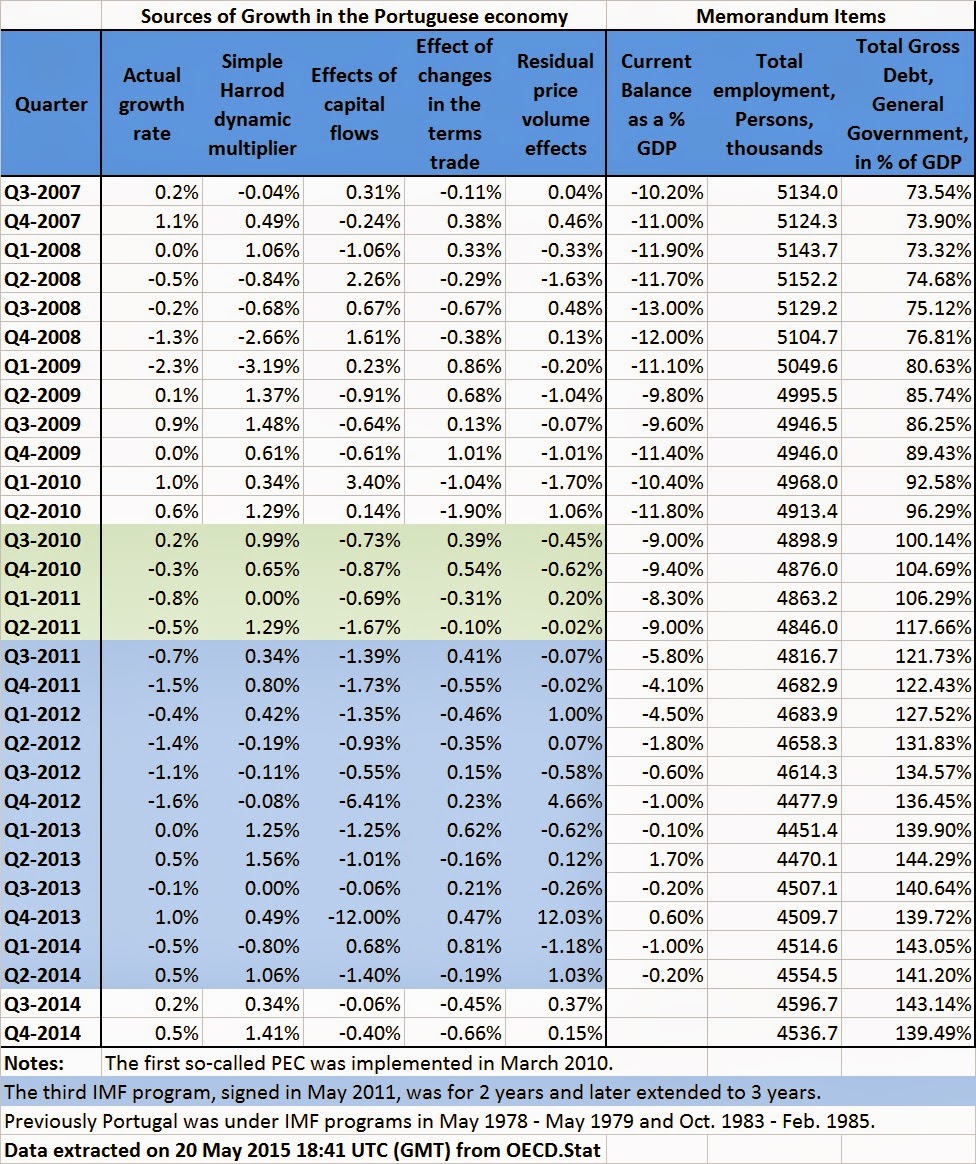
Let us now compare this performance with the current adjustment program for Portugal, as shown in the table below with quarterly values.


During the first year, the pre-Troika PEC adjustment program achieved a reduction in the current account deficit of only 2.8% at a cost of 1.4% in output. The capital effect was responsible for a decline of 3.9% in growth, but was almost offset by a trade multiplier effect of 3.0%.

For the duration of the 3-year IMF adjustment program, the current account deficit was reduced by 8.8 percentage points at a cost of 8.1% in output caused by the program’s effect on capital flows and residual price-volume effects. However, its foreign trade multiplier offset was just 4.8%, which explains why the economic recession has deepened to 5.2% (including the negative impact of terms of a terms of trade improvement brought about an appreciating Euro).

At the end of the program’s three-year period, the adjustment achieved in the current account was similar to that of the previous programs (8.8% against 7.7% and 10.1% in 1978 and 1983, respectively). Yet, this time it took twice as long and the cost in terms of output more than doubled (a 5.2% fall now, against a slowdown of 2.7% in 1978 and a loss of 2.1% in 1983).

In summary:

1) The program achieved its objectives (the current account adjustment and a return to private debt markets); but:
2) It required twice the duration and the output losses of past programs;
3) The banking sector restructuring and fiscal consolidation were negligible. Public debt increased 23.5 percentage points to reach 141.2% of GDP at the end of the program;
4) The social burden was significant, with the unemployment rate rising two percentage points to 14.4%; and
5) There was a minor (0.8%) improvement in productivity because the decline in output was close to the loss of jobs (6%).

For these reasons the Portuguese adjustment must be classified as a pyrrhic victory, which, if repeated, will ruin the country.

Saturday, 15 September 2012

Why the IMF therapy is not working in Ireland

After a remarkable economic success based on market capitalism, Ireland has drifted back into misery since the crisis of 2008 and risks turning into a Southern European type of state capitalism. Back in January 2011 we explained in this blog (see here) why the IMF program for Greece’s external adjustment would not work. Some of the reasons given then apply equally to Ireland (or Spain for that matter).

First, the Troika misdiagnosed the situation as a liquidity problem while in fact Ireland and Greece faced a solvency problem (albeit of a different nature).

Then, they treated the problem of excessive leverage in the wrong way. The two major mistakes in Ireland were the conversion of private debt into public debt and the reliance on internal devaluation to deleverage. It is easy to see why both policies were wrong.

Ireland had a typical situation faced by a family with irresponsible children that took excessive debt to pay for gambling losses at the Casino (or in its case to speculate in real estate). An obvious option to erase gambling debts was to default on the casino loans (in the case of the Irish real estate bubble the British and German banks). They could be charged with allowing bets that the gambler could not pay. One alternative would be to demand a debt restructuring involving partial debt forgiveness and a longer repayment period, so that with the help of family and friends (i. e. grants by national and EU institutions in the case of Irish borrowers) they could repay the remaining debt without damaging the credit of his family. Another alternative would be to ask the casino to accept an IOU without a redemption date (in case of the British and German banks accept money printed by the ECB).

Yet, the casino owners decided instead to force the collection of their loans from the children’s parents (i.e.Irish government). To save its reputation the family promised to honor the debts by putting them in their business balance sheet (the state budget in the case of Ireland). However, the debts were so huge that they would necessarily cripple an otherwise successful business (economy). It is easy to see why.

First, such an increase in leverage would bar the firm from market financing. Second, it would be forced to halt all modernization and maintenance investments. Finally, it would force the family to downsize by selling some of the best assets. Combining these three measures would inevitably lead to a lower competitiveness, declining productivity and a depressed local economy. As expected, in the last four years, investment in Ireland more than halved in real terms, while domestic demand declined by about one third.

However, the recourse to internal devaluation only made things worse. Imagine that the clientele of the parents business was mostly local (i.e. produced non-tradable goods in economists’ parlance). Therefore, cutting the wage of their workers would reduce its sales proportionally and reduce further the firms’ debt capacity.

Moreover, reducing nominal contracts in the labor market without a concomitant reduction in credit markets would inevitably lead to an increase in non-performing loans (which in 2011 indeed rose from 12% to 20%).

It is obvious that the policy of switching the debt burden from the private to the public sector only made things worse in Ireland. What we said about Greece applies equally to Ireland. It has only three options: a) to force a significant hair-cut on its bond-holders, b) to receive a major grant from other EU countries, or c) a mix of both. None of these is a pleasant solution but there is no other way out.

Friday, 14 September 2012

Is the IMF playing ostrich in Ireland?

Since December 2010, Ireland has diligently implemented an adjustment program agreed with the so-called Troika (IMF, ECB and EU). On its 6th review in June 2013, the IMF concluded that: “Ireland’s ownership of the program remains strong and policy implementation has continued to be steadfast despite the considerable challenges. All quantitative targets for the review were met, maintaining the strong performance in earlier reviews. Fiscal, financial, and structural reforms are advancing as envisaged”. Yet, the IMF seems intent on deliberately ignoring its failure (or lying), because it acknowledges in the same report “renewed tensions in the euro area have driven up Irish bond spreads, while growth remains weak and unemployment high”.

Indeed, in terms of both costs and results, the outcome is appalling. Let us look at the results first:

The chart above from the IMF report shows that the borrowing costs are higher than at the start of the program, remain at unsustainable levels and recently have resumed its rising trend. Likewise, the external debt shows no signs of abating, as shown in the next table:

The Irish net external debt position (excluding FDI and Reserves) deteriorated 16.8% (€30 billion) since the start of the program. Moreover, the government takeover of private debts has increased the general government debt from 25% of GDP in 2007 to 108% in 2011 and the IMF forecasts that it will increase to 121% of GDP in 2013.

Finally, let us look at the bank recapitalization. This program was pursued through a staggering increase of Tier I capital to 16%, but it did not solve the banking system solvability and profitability. The IMF table reproduced below shows that equity losses were still 20% in 2011, while the percentage of non-performing loans had increased from 12.1% to 19.5%.

So far for the results!

Unfortunately, the adjustment costs are equally dismal. The following table gives further details:

Suffice to say, Irish production (GNP) is still 11.8% less than it was four years ago and may fall again in 2012. Meanwhile, unemployment has reached 15% and might continue to rise despite a return to massive emigration. For instance, it is estimated that between 1976 and 2011, about 7.5% of native Irish in their twenties emigrated.

With such dismal results obtained at such an appalling cost, one must conclude that the IMF is playing ostrich in Ireland. Indeed, some observers may even wonder whether Ireland will become another Greece. So, it is not too soon to question whether the program is taking too long to work or it is fundamentally flawed.

Friday, 2 December 2011

Is the ECB-IMF Proposed Back-to-Back Loan Enough to Stop the Euro Suicide?

It seems that the ECB is considering moving towards the type of back-to-back loan solution that we advocated in a previous post to stop the speculative bet on the collapse of the Euro. Bloomberg has just announced that the ECB is in talks with the IMF to set up a special $270 billion lending facility that would bypass the legal constraint of acting as lender of last resort to Euro Zone governments.

Although the details are not yet known, this is a positive development. Its main advantage is that it leaves the onus of imposing the necessary conditionality terms to the IMF, a task outside the remit of the ECB. However, the IMF failure in the Greek adjustment program raises serious doubts on its ability to deal with the Euro zone crisis.

We would prefer a European solution, intermediated and co-financed by private banks backed by the reformed European Financial Stability Facility, once it gets competence in adjustment lending.

Still, to be credible the ECB needs to go further. First, it needs to make sure that the size of the facility is big enough to leave no doubt about its power (the $270 billion reported are a fraction of what is needed). Second, it needs to ensure that the IMF can speed up its decision-making process. Finally, and most importantly, needs to stop its programs of bond buying in the secondary market that are feeding the speculation. A substantial reduction in the bond supply issued by some sovereigns is indispensable to squeeze those shorting the Euro.

In conclusion, the ECB has finally taken the first step in the right direction. Let us hope that it is followed by additional measures and is not offset by the fiscal fundamentalism that the surplus countries are trying to impose in whole Euro zone.

Friday, 17 June 2011

The IMF/EU/ECB bailout for Portugal: Structural Reforms

The IMF diagnostic of the Portuguese situation is broadly correct: “deep-rooted structural problems—including low productivity, weak competitiveness, and high debt—severely undermine potential growth”. To re-launch growth the adjustment program includes a set of structural reforms focused on “increasing competition, reducing labor costs, and boosting employment and productivity”.

Yet the end of the dismal growth of the Portuguese economy over the last decade (only 0.7% of annual growth) is not on sight. The cyclical rebound expected for 2013–14 will reach only 2.5% and will decline subsequently to 2%. Unemployment is projected to peak at 13 percent in 2012 and the current account deficit is projected to narrow gradually to 3.4% in 2014. The unemployment and the current account projections seem to be on the optimistic side. In particular the expected strong decline in imports is at odds with the expected growth of exports given the high import content of Portuguese exports.

The five key measures include: a) a fiscal devaluation through the payroll taxes; b) a reform of the housing market; c) a reduction in the backlog of judicial cases; d) increased labor market flexibility by reducing severance pay by 1/3 (10 days) and restricting unemployment benefits; e) reducing the implicit subsidies in the electricity sector and improve the competition framework to rebalance growth towards the tradable sector and reduce rent-seeking behavior; and f) a privatization program aimed at raising €5 billion in revenue.

These measures point in the right direction but are modest and miss some of the major cancers that we identified in the Portuguese economy. For instance, they completely fail to address the widespread system of subsidies that are an important source of corruption, make companies subsidy-dependent and kill true entrepreneurship. Moreover the efficacy of the measures listed above is questionable in some cases.

Namely, the privatization program is too slow and too modest. And, in cases like water supply, it might add to the problems already caused by other privatized utilities. Indeed, the program would need to be supplemented by a nationalization program covering PPPs, the health sector and some utilities.

Likewise improvements in the competitive framework are not enough to solve the rent-seeking problems mining the Portuguese competitiveness. As has been observed in the oil sector collusion among oligopolistic firms is clearly seen but not easily proved. For example, an efficient and competitive solution could be achieved by introducing a leveling field fee to ensure cross border competition.

Most importantly the fiscal devaluation may turn out to be fiscally non-neutral and insufficient. Its broad base makes it a costly solution and the offsetting tax rises will dampen growth. Assuming a likely cut of about 4% this means a one-off reduction in unit costs of less than 2.5%. Thus its impact on growth might not even be enough to offset the reduction in growth caused by the tax rise. In any case this compares poorly with a potential 7% devaluation achieved with our proposal to increase the number of working hours.

In conclusion, although the IMF program points in the right direction it will not reverse the slow growth of the Portuguese economy and may not fulfill the countries ambition to resume the normal access to international markets and to take care of its own destiny. Unless the new government is able to improve and extend the IMF program, I am afraid that we will need soon another bailout.

Wednesday, 15 June 2011

The IMF/EU/ECB bailout of Portugal: Fiscal Stabilization

In our preliminary reaction to the IMF/EU/ECB €78 billion bailout for Portugal we thought it looked like too little, too late and too soft. We promised then a full verdict once the details of the program were known. This is the first part covering fiscal consolidation.

In contrast with Greece, at the outset, the Portuguese program has only two criteria of quantitative performance – a General Government deficit of €10.3 billion in 2011 to be reduced to €7.6 billion in 2012 and a ceiling on the overall stock of General Government debt of €175.9 billion in 2011 and €189.4 billion in 2012. With nominal GDP forecasted to decline by 1.1% it will be only €170.6 billion in 2011.
MJMDV6UTZD32
Under the IMF projections the program of fiscal stabilization will cut the deficit from an average of 9.6% of GDP (€16.5 billion) in 2009-2010 to 3% in 2013. This is achieved through a projected growth of revenues equivalent to 0.8% of GDP and a reduction in spending equal to 5.4% of GDP. The increased revenue target of €2 billion will be achieved mostly through VAT rises and reductions in tax benefits. The bulk of the €9 billion in expenditure cuts will be achieved by freezing the nominal wages of civil servants until 2013, an average cut of 3% on pensions above €1500 (a similar cut was already made to civil servants wages), downsizing the central government, saving in healthcare and education, cutting public sector investment and reducing transfers for loss making state-owned enterprises.

The program of fiscal consolidation must be judged on three fronts – compliance probability, future sustainability, burden sharing and macro-economic impact.

The targets seem to have been set deliberately low so that they can be met. We have estimated that only to roll back the excess spending of the Socialist Governments Portugal needs cuts amounting to at least 8% of GDP. Yet, there are still some uncertainties that are worth noting. On the revenue side the fiscal neutrality of the cut in payroll taxes is not certain. However, it is on the expenditure side that the resistance is going to be greater. In particular, in terms of downsizing the government, controlling health costs and reducing transfers to state-owned enterprises.

In terms of future sustainability the targets are not only timid but uncertain. For instance, the program of privatizations is targeted at raising only €5.5 billion. So, the IMF forecasts still assume a significant rise in public debt to 115% of GDP in 2014 in an economy that is not expected to grow at more than 2% in the post-recession period. In the context of continuing speculation against the weak links in the Euro Area this will not allow Portugal’s return to the market at reasonable interest rates. Moreover, three of the major public finance problems (unknown payment arrears, off-balance sheet debt and guarantees to banks and PPPs and the need for a full fiscal reform) are only left for further study.

In what concerns the fairness of burden distribution, the program is clearly biased against the lower and upper middle classes and the civil servants. Moreover, it barely touches the subsidization of privatized monopolies and other special interest groups. Again, these are only left for further study.

Finally, the macro-economic consequences of the fiscal adjustment point to a negative contribution to growth of 1.4% in 2011 and 1% in 2012. This seems a little optimistic especially when compared to a 2.9% negative contribution of private consumption (which includes civil servants and pensioners). The IMF attempt to avoid a sharper recession is reasonable, but it is unlikely to succeed given the foreseeable slowdown in the global economy and the generalized lack of confidence in the long term growth prospects of the country.

In conclusion, a timid program of fiscal consolidation in a context of global uncertainty might allow the country to get by in the next two years. Whether it will be enough to avoid the need for another future bailout and or debt restructuring is doubtful.