By electing the Syriza party, the Greeks in despair have turned what was an untenable situation into a nightmare scenario, perhaps hoping to force some kind of way out from the present situation.
What are in fact the Greek options? Using my academic hat I will put them bluntly and leave to others the task of dressing them in politically correct language. The options are basically three.
The first is that once in power, Tsipras and other radical leaders in the coalition will become realists and will not rock the boat. The second is that he will try to implement his political and economic agenda and will end up in mayhem and forced out of the Euro, or, in a worst case scenario, exit the EU and fall back into dictatorship. The third option is that he will declare a moratorium or some other form of debt default and will end up being bailed out again by the Troika.
There are several international experiences we may use as an analogy for each scenario.
The “get real” hypothesis has two versions: a) the FT hope that Tsipras becomes a Lula da Silva rather than a Hugo Chaves; and, b) Krugman’s (socialist) wishful thinking that the sudden abandonment of austerity will revive the Greek economy and the political mess will disappear. Both are very unlikely. The first, because the ideological base of Tsipras is fundamentally different from that of the Lula’s party in Brazil and the financial situation is much worse in Greece. The second ignores that the moderate socialist left has been almost wiped out of the political map and replaced by radicals without previous government experience.
The “mayhem and Euro exit” scenario is the most dangerous for Greece and Europe, if one judges from historical precedents such as the Cuban revolution or the rise of Nazism in Germany. One should not forget that it was economic anarchy, national humiliation, anti-Semitism and the fear of communism that led the Germans to vote Hitler into power. The fact that Syriza has chosen as coalition partner a nationalistic anti-Semite party and left-wing leaders in Southern Europe are increasingly endorsing anti-Semitism under the guise of pro-Palestinian support, creates an environment favorable to the Greek Golden Dawn neo-Nazi party which came third in the election.
The “new debt restructuring and new bailout” is the lesser of the three evils. In practice it means that the Troika needs to develop a new financing mechanism to lend Greece the money they need to repay their debt. This way of preventing a formal write-off of loans from international financial institutions, which enjoy preferred creditor status, has been used by the World Bank through AID lending and by the IMF through the HIPC/MDRI and PRGT Initiatives. Two countries with recently overdue repayments to the IMF were Zimbabwe and Argentina. Both with left-leaning, populist leaders who decided to challenge the international lenders. The results have been years of economic decline and rampant corruption. So, Greece, a country already rigged by alarming levels of corruption, might follow their path. However, for the good of Greece, one should hope that Tsipras will be more like Cristina Kirchner than Robert Mugabe.
To close this rather bleak outlook, I must address the question on whether there are no solutions for the Greek problem. Yes, there are. And I have written about some of them in other posts (e.g. here and here) in 2011, at the start of the Southern European crisis.
However, I do not foresee a possibility that someone will endorse them before the Greek electorates gets disillusioned with the new utopia, votes for more reliable politicians and the EU leaders reconsider their austerity bias. I hope that time will prove me wrong.
Showing posts with label IMF. Show all posts
Showing posts with label IMF. Show all posts
Monday, 26 January 2015


Saturday, 3 November 2012
Why the IMF therapy is not working in Portugal
The IMF repeats in Portugal the ostrich policy of not recognizing what is fundamentally wrong with its adjustment approach in the Euro Area. In its 5th review of the Portuguese program it states that “authorities have made good progress in reducing macroeconomic imbalances … But after a strong start, the program has entered a more challenging phase … a large and durable fiscal gap has emerged due to a shift in the composition of output from domestic demand to less-taxed net-exports”.
Despite the initial Portuguese external disequilibrium being milder than the Greek or Irish, I anticipated that the program was likely to fail because it had been undertaken reluctantly, too late, with too little and it was too soft. Moreover, its management was weak, incompetent and erratic partly because the Troika was desperate to have a success story and it had in Portugal a Finance Minister – Victor Gaspar – that was seen as one of their men. So, all tough measures (e.g. reducing the number of municipalities and monopolistic rents) were abandoned or reversed. For instance, fiscal consolidation which was to be implemented by 2/3 of expenditure cuts and 1/3 of revenue measures failed completely with the expenditure hardly slowing down and the revenue collapsing.
By now the IMF had to agree to extend its program for one more year and to grant some waivers, while it is already busy working on another package that will inevitably result on more time and more money. This will only raise the Portuguese external debt to new heights without any visible improvement in its economic growth.
Just as a reminder, note that the Greek debt path under IMF management, which started in May 2010 with a general government debt equivalent to 115% of GDP and was supposed to peak in 2012 at 149%, at the start of the second IMF bailout in June 2012 had already reached 165% and is expected to peak at 171% in 2014. For comparison, in Greece the total net external debt rose from 87 to 107% of GDP between 2009 and 2012 while in Portugal (external debt, excluding FDI and reserves) rose only from 98 to 99% of GDP. However, the portion owed by the government increased from 64 to 95% of GDP, degenerating into a sovereign debt crisis.
In a recent post we called the current IMF (Troika) adjustment program for Portugal a pyrrhic victory because, when compared to previous programs, it had doubled the cost of external adjustment in terms of output loss. We identified as the main culprit a weak foreign trade multiplier. So, the key question is why isn´t the trade multiplier working now as it did in past programs? As we calculated the multiplier effect by assuming a constant income elasticity of demand for imports the explanation must be accounted for by a sluggish international economic growth and or changes in relative prices (terms of trade).
In fact, the growth of the world economy accounts for a small portion of the reduced multiplier effect, since the OECD was growing at 6% during the first two programs but recently it has been growing at only 4.3%. So, the majority (71%) of the blame for the smaller multiplier effect lies in a weak export performance because of lower price elasticities and adverse changes in the terms of trade. Since recent estimates show that the export price elasticity remains low (0.42) and statistically is not significantly different from zero, the core explanation must lie in the terms of trade.
The Portuguese terms of trade did not deteriorate enough to drive a higher level of economic activity because of an irresponsible fiscal policy of indirect tax increases that caused a futile destruction of businesses in the non-tradable goods sector and the failure to confront the powerful lobbies in the energy and transport sectors that hamper the tradable goods sector. This trend in the terms of trade is clearly visible in the following chart.

The persistence of domestic inflationary forces despite an increase of 3.5 percentage points in the unemployment rate which reached 15.5% can only be the result of market rigidities compounded by fiscal mistakes.
The program of fiscal consolidation was not only inefficient, but foolish and poorly sequenced. Instead of targeting the preservation or a small rise in revenue, through the broadening of the tax base and selective competitive tax cuts, combined with substantial cuts in subsidies and other wasteful forms of spending it did the reverse. In terms of sequencing, instead of beginning with spending cuts, followed by a broadening of the income tax base and cuts in corporate taxes it did the reverse. It raised indirect taxes first at the expense of external competitiveness and is now promising a massive increase in income and corporate taxes for 2013 to be followed by spending cuts in 2014, thus perpetuating unnecessarily the current recession for at least another two years.
In conclusion, the program left untouched all the cancers blocking the growth of the Portuguese economy listed in this blog long ago as being: irresponsible recourse to PPP financing, large rent-seeking privatized monopolies, extensive subsidization of energy, environment, technological and other self-serving mafias, too many, too inefficient and too indebted State enterprises for the exclusive benefit of their managers, unions and bankers, a financial sector who suckles on public financing, the uncontrollable spending of the health and social security sectors, the destruction of a professionally independent public service, dysfunctional fiscal and judicial systems and generalized recourse to off-budget operations and creative accounting. Indeed, it made things worse through mismanagement. So, without changing course, Portugal is condemned to more than a decade of slow growth and unbearable indebtedness and sooner or later it will have to default or ask for debt forgiveness for the first time since 1892.
As a Portuguese I am saddened to see my beloved country ravaged by an incompetent government in collusion with useless international organizations at the mercy of an unholy alliance of heartless Teutonic European mandarins, predatory Chinese and Angolan dictators and dubious Latin American business interests. This is the end result of 80 years of state capitalism in Portugal.
Despite the initial Portuguese external disequilibrium being milder than the Greek or Irish, I anticipated that the program was likely to fail because it had been undertaken reluctantly, too late, with too little and it was too soft. Moreover, its management was weak, incompetent and erratic partly because the Troika was desperate to have a success story and it had in Portugal a Finance Minister – Victor Gaspar – that was seen as one of their men. So, all tough measures (e.g. reducing the number of municipalities and monopolistic rents) were abandoned or reversed. For instance, fiscal consolidation which was to be implemented by 2/3 of expenditure cuts and 1/3 of revenue measures failed completely with the expenditure hardly slowing down and the revenue collapsing.
By now the IMF had to agree to extend its program for one more year and to grant some waivers, while it is already busy working on another package that will inevitably result on more time and more money. This will only raise the Portuguese external debt to new heights without any visible improvement in its economic growth.
Just as a reminder, note that the Greek debt path under IMF management, which started in May 2010 with a general government debt equivalent to 115% of GDP and was supposed to peak in 2012 at 149%, at the start of the second IMF bailout in June 2012 had already reached 165% and is expected to peak at 171% in 2014. For comparison, in Greece the total net external debt rose from 87 to 107% of GDP between 2009 and 2012 while in Portugal (external debt, excluding FDI and reserves) rose only from 98 to 99% of GDP. However, the portion owed by the government increased from 64 to 95% of GDP, degenerating into a sovereign debt crisis.
In a recent post we called the current IMF (Troika) adjustment program for Portugal a pyrrhic victory because, when compared to previous programs, it had doubled the cost of external adjustment in terms of output loss. We identified as the main culprit a weak foreign trade multiplier. So, the key question is why isn´t the trade multiplier working now as it did in past programs? As we calculated the multiplier effect by assuming a constant income elasticity of demand for imports the explanation must be accounted for by a sluggish international economic growth and or changes in relative prices (terms of trade).
In fact, the growth of the world economy accounts for a small portion of the reduced multiplier effect, since the OECD was growing at 6% during the first two programs but recently it has been growing at only 4.3%. So, the majority (71%) of the blame for the smaller multiplier effect lies in a weak export performance because of lower price elasticities and adverse changes in the terms of trade. Since recent estimates show that the export price elasticity remains low (0.42) and statistically is not significantly different from zero, the core explanation must lie in the terms of trade.
The Portuguese terms of trade did not deteriorate enough to drive a higher level of economic activity because of an irresponsible fiscal policy of indirect tax increases that caused a futile destruction of businesses in the non-tradable goods sector and the failure to confront the powerful lobbies in the energy and transport sectors that hamper the tradable goods sector. This trend in the terms of trade is clearly visible in the following chart.

The persistence of domestic inflationary forces despite an increase of 3.5 percentage points in the unemployment rate which reached 15.5% can only be the result of market rigidities compounded by fiscal mistakes.
The program of fiscal consolidation was not only inefficient, but foolish and poorly sequenced. Instead of targeting the preservation or a small rise in revenue, through the broadening of the tax base and selective competitive tax cuts, combined with substantial cuts in subsidies and other wasteful forms of spending it did the reverse. In terms of sequencing, instead of beginning with spending cuts, followed by a broadening of the income tax base and cuts in corporate taxes it did the reverse. It raised indirect taxes first at the expense of external competitiveness and is now promising a massive increase in income and corporate taxes for 2013 to be followed by spending cuts in 2014, thus perpetuating unnecessarily the current recession for at least another two years.
In conclusion, the program left untouched all the cancers blocking the growth of the Portuguese economy listed in this blog long ago as being: irresponsible recourse to PPP financing, large rent-seeking privatized monopolies, extensive subsidization of energy, environment, technological and other self-serving mafias, too many, too inefficient and too indebted State enterprises for the exclusive benefit of their managers, unions and bankers, a financial sector who suckles on public financing, the uncontrollable spending of the health and social security sectors, the destruction of a professionally independent public service, dysfunctional fiscal and judicial systems and generalized recourse to off-budget operations and creative accounting. Indeed, it made things worse through mismanagement. So, without changing course, Portugal is condemned to more than a decade of slow growth and unbearable indebtedness and sooner or later it will have to default or ask for debt forgiveness for the first time since 1892.
As a Portuguese I am saddened to see my beloved country ravaged by an incompetent government in collusion with useless international organizations at the mercy of an unholy alliance of heartless Teutonic European mandarins, predatory Chinese and Angolan dictators and dubious Latin American business interests. This is the end result of 80 years of state capitalism in Portugal.
Tuesday, 30 October 2012
Portugal´s External Adjustment: a Pyrrhic victory
(Post initially published on 30/10/2012. Since the program is now finished we updated in May 2015 the last table with the impact on economic growth and its analysis. The rest of the text and our conclusion remain the same.)
A pyrrhic war is a war won at too high a cost. As Pyrrhus said, in 280 BC: "If we are victorious in one more battle with the Romans, we shall be utterly ruined". Recently, Ireland, Spain and Portugal achieved sharp reductions in their current account deficits as depicted in the table below.
 Let us examine if these results are similar to a pyrrhic victory.
Indeed, the costs in terms of lost production and related increase in unemployment shown in the table below were so high for Greece and Portugal that one must ask whether for these countries the victors have weakened their economies to a point where they were trapped into a permanent state of lower income and productivity.

There are five basic reasons to fear that it might be the case. First, the adjustment was achieved almost exclusively through output and capacity reduction. Second, the massive conversion of private debt into public debt increased the cost of leverage for all and for a long time which crowded out the most dynamic sector of the economy – the SMEs. Third, the recurrent need for never ending tax increases created a persistent trend for appreciation in their foreign terms of trade, when they needed the opposite. Fourth, it created a permanent stimulus for capital flight. And, finally the resulting increase in long term unemployment raised the level of structural unemployment to unbearable levels.
The case of Portugal is especially illustrative because it has duly taken its medicine and achieved the sharpest external correction. We will examine causes one and three above by comparing the current adjustment to that of previous IMF programs in the 1970s and 1980s. The exercise can be done using the financial accounts or through Thirlwall´s balance payments constrained growth accounting framework. I use the later approach to compare the current situation with a similar study I did 20 years ago and which is summarized in the following table with a breakdown of the sources of GDP growth.

The success of the two previous programs can be judged by the reduction in the current account deficit over the first two years and the corresponding cost in terms of output decline. In the first program a reduction of 7.7 percentage points in the current account deficit triggered a slowdown in economic growth only in the first year. The second program achieved a deficit reduction of 10.1 percentage points at a cost of a two-year recession that reduced GDP by 2.1%.
In both programs we measured the role played by the foreign trade multiplier to offset the decline in growth caused by the reduction in capital inflows. In the first program a fall in output due to capital flows of 11.2% was more than offset by a multiplier effect of 19.2%. In the second program a loss of 21.2% caused by a reversal of capital inflows was offset only partially by a 14.5% multiplier effect, but overall in the third year the economy had recovered from the output losses incurred during the 1983-84 recession.
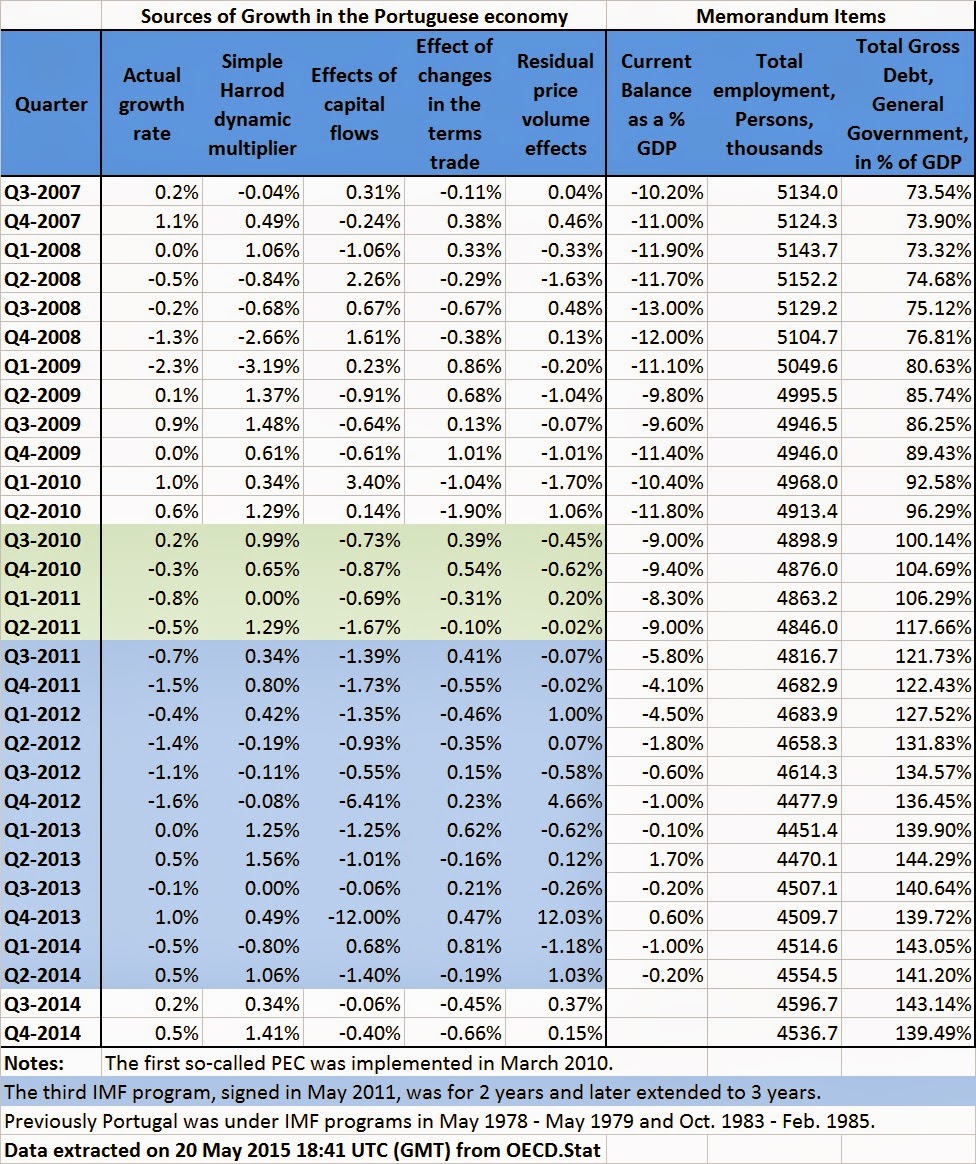
Let us now compare this performance with the current adjustment program for Portugal, as shown in the table below with quarterly values.

During the first year, the pre-Troika PEC adjustment program achieved a reduction in the current account deficit of only 2.8% at a cost of 1.4% in output. The capital effect was responsible for a decline of 3.9% in growth, but was almost offset by a trade multiplier effect of 3.0%.
For the duration of the 3-year IMF adjustment program, the current account deficit was reduced by 8.8 percentage points at a cost of 8.1% in output caused by the program’s effect on capital flows and residual price-volume effects. However, its foreign trade multiplier offset was just 4.8%, which explains why the economic recession has deepened to 5.2% (including the negative impact of terms of a terms of trade improvement brought about an appreciating Euro).
At the end of the program’s three-year period, the adjustment achieved in the current account was similar to that of the previous programs (8.8% against 7.7% and 10.1% in 1978 and 1983, respectively). Yet, this time it took twice as long and the cost in terms of output more than doubled (a 5.2% fall now, against a slowdown of 2.7% in 1978 and a loss of 2.1% in 1983).
In summary:
1) The program achieved its objectives (the current account adjustment and a return to private debt markets); but:
2) It required twice the duration and the output losses of past programs;
3) The banking sector restructuring and fiscal consolidation were negligible. Public debt increased 23.5 percentage points to reach 141.2% of GDP at the end of the program;
4) The social burden was significant, with the unemployment rate rising two percentage points to 14.4%; and
5) There was a minor (0.8%) improvement in productivity because the decline in output was close to the loss of jobs (6%).
For these reasons the Portuguese adjustment must be classified as a pyrrhic victory, which, if repeated, will ruin the country.
A pyrrhic war is a war won at too high a cost. As Pyrrhus said, in 280 BC: "If we are victorious in one more battle with the Romans, we shall be utterly ruined". Recently, Ireland, Spain and Portugal achieved sharp reductions in their current account deficits as depicted in the table below.

Indeed, the costs in terms of lost production and related increase in unemployment shown in the table below were so high for Greece and Portugal that one must ask whether for these countries the victors have weakened their economies to a point where they were trapped into a permanent state of lower income and productivity.

There are five basic reasons to fear that it might be the case. First, the adjustment was achieved almost exclusively through output and capacity reduction. Second, the massive conversion of private debt into public debt increased the cost of leverage for all and for a long time which crowded out the most dynamic sector of the economy – the SMEs. Third, the recurrent need for never ending tax increases created a persistent trend for appreciation in their foreign terms of trade, when they needed the opposite. Fourth, it created a permanent stimulus for capital flight. And, finally the resulting increase in long term unemployment raised the level of structural unemployment to unbearable levels.
The case of Portugal is especially illustrative because it has duly taken its medicine and achieved the sharpest external correction. We will examine causes one and three above by comparing the current adjustment to that of previous IMF programs in the 1970s and 1980s. The exercise can be done using the financial accounts or through Thirlwall´s balance payments constrained growth accounting framework. I use the later approach to compare the current situation with a similar study I did 20 years ago and which is summarized in the following table with a breakdown of the sources of GDP growth.

The success of the two previous programs can be judged by the reduction in the current account deficit over the first two years and the corresponding cost in terms of output decline. In the first program a reduction of 7.7 percentage points in the current account deficit triggered a slowdown in economic growth only in the first year. The second program achieved a deficit reduction of 10.1 percentage points at a cost of a two-year recession that reduced GDP by 2.1%.
In both programs we measured the role played by the foreign trade multiplier to offset the decline in growth caused by the reduction in capital inflows. In the first program a fall in output due to capital flows of 11.2% was more than offset by a multiplier effect of 19.2%. In the second program a loss of 21.2% caused by a reversal of capital inflows was offset only partially by a 14.5% multiplier effect, but overall in the third year the economy had recovered from the output losses incurred during the 1983-84 recession.
Let us now compare this performance with the current adjustment program for Portugal, as shown in the table below with quarterly values.
During the first year, the pre-Troika PEC adjustment program achieved a reduction in the current account deficit of only 2.8% at a cost of 1.4% in output. The capital effect was responsible for a decline of 3.9% in growth, but was almost offset by a trade multiplier effect of 3.0%.
For the duration of the 3-year IMF adjustment program, the current account deficit was reduced by 8.8 percentage points at a cost of 8.1% in output caused by the program’s effect on capital flows and residual price-volume effects. However, its foreign trade multiplier offset was just 4.8%, which explains why the economic recession has deepened to 5.2% (including the negative impact of terms of a terms of trade improvement brought about an appreciating Euro).
At the end of the program’s three-year period, the adjustment achieved in the current account was similar to that of the previous programs (8.8% against 7.7% and 10.1% in 1978 and 1983, respectively). Yet, this time it took twice as long and the cost in terms of output more than doubled (a 5.2% fall now, against a slowdown of 2.7% in 1978 and a loss of 2.1% in 1983).
In summary:
1) The program achieved its objectives (the current account adjustment and a return to private debt markets); but:
2) It required twice the duration and the output losses of past programs;
3) The banking sector restructuring and fiscal consolidation were negligible. Public debt increased 23.5 percentage points to reach 141.2% of GDP at the end of the program;
4) The social burden was significant, with the unemployment rate rising two percentage points to 14.4%; and
5) There was a minor (0.8%) improvement in productivity because the decline in output was close to the loss of jobs (6%).
For these reasons the Portuguese adjustment must be classified as a pyrrhic victory, which, if repeated, will ruin the country.
Saturday, 15 September 2012
Why the IMF therapy is not working in Ireland
After a remarkable economic success based on market capitalism, Ireland has drifted back into misery since the crisis of 2008 and risks turning into a Southern European type of state capitalism. Back in January 2011 we explained in this blog (see here) why the IMF program for Greece’s external adjustment would not work. Some of the reasons given then apply equally to Ireland (or Spain for that matter).
First, the Troika misdiagnosed the situation as a liquidity problem while in fact Ireland and Greece faced a solvency problem (albeit of a different nature).
Then, they treated the problem of excessive leverage in the wrong way. The two major mistakes in Ireland were the conversion of private debt into public debt and the reliance on internal devaluation to deleverage. It is easy to see why both policies were wrong.
Ireland had a typical situation faced by a family with irresponsible children that took excessive debt to pay for gambling losses at the Casino (or in its case to speculate in real estate). An obvious option to erase gambling debts was to default on the casino loans (in the case of the Irish real estate bubble the British and German banks). They could be charged with allowing bets that the gambler could not pay. One alternative would be to demand a debt restructuring involving partial debt forgiveness and a longer repayment period, so that with the help of family and friends (i. e. grants by national and EU institutions in the case of Irish borrowers) they could repay the remaining debt without damaging the credit of his family. Another alternative would be to ask the casino to accept an IOU without a redemption date (in case of the British and German banks accept money printed by the ECB).
Yet, the casino owners decided instead to force the collection of their loans from the children’s parents (i.e.Irish government). To save its reputation the family promised to honor the debts by putting them in their business balance sheet (the state budget in the case of Ireland). However, the debts were so huge that they would necessarily cripple an otherwise successful business (economy). It is easy to see why.
First, such an increase in leverage would bar the firm from market financing. Second, it would be forced to halt all modernization and maintenance investments. Finally, it would force the family to downsize by selling some of the best assets. Combining these three measures would inevitably lead to a lower competitiveness, declining productivity and a depressed local economy. As expected, in the last four years, investment in Ireland more than halved in real terms, while domestic demand declined by about one third.
However, the recourse to internal devaluation only made things worse. Imagine that the clientele of the parents business was mostly local (i.e. produced non-tradable goods in economists’ parlance). Therefore, cutting the wage of their workers would reduce its sales proportionally and reduce further the firms’ debt capacity.
Moreover, reducing nominal contracts in the labor market without a concomitant reduction in credit markets would inevitably lead to an increase in non-performing loans (which in 2011 indeed rose from 12% to 20%).
It is obvious that the policy of switching the debt burden from the private to the public sector only made things worse in Ireland. What we said about Greece applies equally to Ireland. It has only three options: a) to force a significant hair-cut on its bond-holders, b) to receive a major grant from other EU countries, or c) a mix of both. None of these is a pleasant solution but there is no other way out.
First, the Troika misdiagnosed the situation as a liquidity problem while in fact Ireland and Greece faced a solvency problem (albeit of a different nature).
Then, they treated the problem of excessive leverage in the wrong way. The two major mistakes in Ireland were the conversion of private debt into public debt and the reliance on internal devaluation to deleverage. It is easy to see why both policies were wrong.
Ireland had a typical situation faced by a family with irresponsible children that took excessive debt to pay for gambling losses at the Casino (or in its case to speculate in real estate). An obvious option to erase gambling debts was to default on the casino loans (in the case of the Irish real estate bubble the British and German banks). They could be charged with allowing bets that the gambler could not pay. One alternative would be to demand a debt restructuring involving partial debt forgiveness and a longer repayment period, so that with the help of family and friends (i. e. grants by national and EU institutions in the case of Irish borrowers) they could repay the remaining debt without damaging the credit of his family. Another alternative would be to ask the casino to accept an IOU without a redemption date (in case of the British and German banks accept money printed by the ECB).
Yet, the casino owners decided instead to force the collection of their loans from the children’s parents (i.e.Irish government). To save its reputation the family promised to honor the debts by putting them in their business balance sheet (the state budget in the case of Ireland). However, the debts were so huge that they would necessarily cripple an otherwise successful business (economy). It is easy to see why.
First, such an increase in leverage would bar the firm from market financing. Second, it would be forced to halt all modernization and maintenance investments. Finally, it would force the family to downsize by selling some of the best assets. Combining these three measures would inevitably lead to a lower competitiveness, declining productivity and a depressed local economy. As expected, in the last four years, investment in Ireland more than halved in real terms, while domestic demand declined by about one third.
However, the recourse to internal devaluation only made things worse. Imagine that the clientele of the parents business was mostly local (i.e. produced non-tradable goods in economists’ parlance). Therefore, cutting the wage of their workers would reduce its sales proportionally and reduce further the firms’ debt capacity.
Moreover, reducing nominal contracts in the labor market without a concomitant reduction in credit markets would inevitably lead to an increase in non-performing loans (which in 2011 indeed rose from 12% to 20%).
It is obvious that the policy of switching the debt burden from the private to the public sector only made things worse in Ireland. What we said about Greece applies equally to Ireland. It has only three options: a) to force a significant hair-cut on its bond-holders, b) to receive a major grant from other EU countries, or c) a mix of both. None of these is a pleasant solution but there is no other way out.
Friday, 14 September 2012
Is the IMF playing ostrich in Ireland?
Since December 2010, Ireland has diligently implemented an adjustment program agreed with the so-called Troika (IMF, ECB and EU). On its 6th review in June 2013, the IMF concluded that: “Ireland’s ownership of the program remains strong and policy implementation has continued to be steadfast despite the considerable challenges. All quantitative targets for the review were met, maintaining the strong performance in earlier reviews. Fiscal, financial, and structural reforms are advancing as envisaged”. Yet, the IMF seems intent on deliberately ignoring its failure (or lying), because it acknowledges in the same report “renewed tensions in the euro area have driven up Irish bond spreads, while growth remains weak and unemployment high”.
Indeed, in terms of both costs and results, the outcome is appalling. Let us look at the results first:

The chart above from the IMF report shows that the borrowing costs are higher than at the start of the program, remain at unsustainable levels and recently have resumed its rising trend. Likewise, the external debt shows no signs of abating, as shown in the next table:

The Irish net external debt position (excluding FDI and Reserves) deteriorated 16.8% (€30 billion) since the start of the program. Moreover, the government takeover of private debts has increased the general government debt from 25% of GDP in 2007 to 108% in 2011 and the IMF forecasts that it will increase to 121% of GDP in 2013.
Finally, let us look at the bank recapitalization. This program was pursued through a staggering increase of Tier I capital to 16%, but it did not solve the banking system solvability and profitability. The IMF table reproduced below shows that equity losses were still 20% in 2011, while the percentage of non-performing loans had increased from 12.1% to 19.5%.

So far for the results!
Unfortunately, the adjustment costs are equally dismal. The following table gives further details:

Suffice to say, Irish production (GNP) is still 11.8% less than it was four years ago and may fall again in 2012. Meanwhile, unemployment has reached 15% and might continue to rise despite a return to massive emigration. For instance, it is estimated that between 1976 and 2011, about 7.5% of native Irish in their twenties emigrated.
With such dismal results obtained at such an appalling cost, one must conclude that the IMF is playing ostrich in Ireland. Indeed, some observers may even wonder whether Ireland will become another Greece. So, it is not too soon to question whether the program is taking too long to work or it is fundamentally flawed.
Indeed, in terms of both costs and results, the outcome is appalling. Let us look at the results first:

The chart above from the IMF report shows that the borrowing costs are higher than at the start of the program, remain at unsustainable levels and recently have resumed its rising trend. Likewise, the external debt shows no signs of abating, as shown in the next table:

The Irish net external debt position (excluding FDI and Reserves) deteriorated 16.8% (€30 billion) since the start of the program. Moreover, the government takeover of private debts has increased the general government debt from 25% of GDP in 2007 to 108% in 2011 and the IMF forecasts that it will increase to 121% of GDP in 2013.
Finally, let us look at the bank recapitalization. This program was pursued through a staggering increase of Tier I capital to 16%, but it did not solve the banking system solvability and profitability. The IMF table reproduced below shows that equity losses were still 20% in 2011, while the percentage of non-performing loans had increased from 12.1% to 19.5%.

So far for the results!
Unfortunately, the adjustment costs are equally dismal. The following table gives further details:

Suffice to say, Irish production (GNP) is still 11.8% less than it was four years ago and may fall again in 2012. Meanwhile, unemployment has reached 15% and might continue to rise despite a return to massive emigration. For instance, it is estimated that between 1976 and 2011, about 7.5% of native Irish in their twenties emigrated.
With such dismal results obtained at such an appalling cost, one must conclude that the IMF is playing ostrich in Ireland. Indeed, some observers may even wonder whether Ireland will become another Greece. So, it is not too soon to question whether the program is taking too long to work or it is fundamentally flawed.
Friday, 9 December 2011
Is the ECB Intent on Replacing Euro Hara-Kiri by Euthanasia?
Another useless EU Summit - thank you Mr. Cameron for killing the new “Merkozy” version of an absurd fiscal union for the entire EU. This time, the absurdity of setting a budget limit of 0.5% of GDP (when it has been unable to comply with the existing limit of 3%), was compounded by requiring its inscription as a rule in national legal systems at constitutional or equivalent level (see here why this is a mistake).
Let us now hope that a referendum in Ireland or any other country will kill the alternative proposal for a fiscal union among Euro Zone members through a new "fiscal compact". As we said here, a fiscal union between Germany and France may make sense but it would be a disaster for the entire Euro Zone.
The potential collapse of the Euro Zone will not be due to a fiscal problem in the Euro Area; which does not exist, despite the fact that three smaller members have excessive debt and Germany has an excessive current account surplus. The problem resides in the ECB’s refusal to act to stop the speculation against the Euro by invoking that its charter does not allow for the monetization of fiscal deficits.
Mr. Draghi is either naïve or wants us to believe in fairy tales. During his last press conference, he said that funding the IMF to finance exclusively the Euro Zone governments would be against the ECB charter. However, the ECB practice of accepting modern day versions of accommodation bills, in the form of bank drafts and bonds issued and subscribed by the same bank with a government guarantee and used to purchase the debt of the said government, is a more dangerous form of debt monetization since it lacks any kind of conditionality. Moreover, it puts those governments in the position of sitting ducks for speculative attacks.
As we said before bank-to-bank loans with strong conditionality are preferable. Obviously, we do not advocate that the ECB should negotiate or monitor such conditionality. Specialized institutions such as the IMF or the EFSF/ESM should do that.
Unfortunately, as we said repeatedly and the experience of Greece, Ireland and Portugal shows the IMF adjustment policies for monetary unions are seriously flawed.
Yet the ECB did not demand from the European Council that the ESM should take its place. Instead, the Council decided that all EU member states would lend to the IMF an extra 200 million Euros in the hope that non-EU countries might do the same.
In summary, by accepting the self-inflicted fiscal Darwinism of Germany that will lead to expelling peripheral countries from the Euro Zone, despite a half-baked mix of ECB and IMF support, will not restore confidence in the Euro. All it does is to replace the previous ECB hara-kiri intent with a slow euthanasia carried out by an IMF firing squad.
Let us now hope that a referendum in Ireland or any other country will kill the alternative proposal for a fiscal union among Euro Zone members through a new "fiscal compact". As we said here, a fiscal union between Germany and France may make sense but it would be a disaster for the entire Euro Zone.
The potential collapse of the Euro Zone will not be due to a fiscal problem in the Euro Area; which does not exist, despite the fact that three smaller members have excessive debt and Germany has an excessive current account surplus. The problem resides in the ECB’s refusal to act to stop the speculation against the Euro by invoking that its charter does not allow for the monetization of fiscal deficits.
Mr. Draghi is either naïve or wants us to believe in fairy tales. During his last press conference, he said that funding the IMF to finance exclusively the Euro Zone governments would be against the ECB charter. However, the ECB practice of accepting modern day versions of accommodation bills, in the form of bank drafts and bonds issued and subscribed by the same bank with a government guarantee and used to purchase the debt of the said government, is a more dangerous form of debt monetization since it lacks any kind of conditionality. Moreover, it puts those governments in the position of sitting ducks for speculative attacks.
As we said before bank-to-bank loans with strong conditionality are preferable. Obviously, we do not advocate that the ECB should negotiate or monitor such conditionality. Specialized institutions such as the IMF or the EFSF/ESM should do that.
Unfortunately, as we said repeatedly and the experience of Greece, Ireland and Portugal shows the IMF adjustment policies for monetary unions are seriously flawed.
Yet the ECB did not demand from the European Council that the ESM should take its place. Instead, the Council decided that all EU member states would lend to the IMF an extra 200 million Euros in the hope that non-EU countries might do the same.
In summary, by accepting the self-inflicted fiscal Darwinism of Germany that will lead to expelling peripheral countries from the Euro Zone, despite a half-baked mix of ECB and IMF support, will not restore confidence in the Euro. All it does is to replace the previous ECB hara-kiri intent with a slow euthanasia carried out by an IMF firing squad.
Friday, 2 December 2011
Is the ECB-IMF Proposed Back-to-Back Loan Enough to Stop the Euro Suicide?
It seems that the ECB is considering moving towards the type of back-to-back loan solution that we advocated in a previous post to stop the speculative bet on the collapse of the Euro. Bloomberg has just announced that the ECB is in talks with the IMF to set up a special $270 billion lending facility that would bypass the legal constraint of acting as lender of last resort to Euro Zone governments.
Although the details are not yet known, this is a positive development. Its main advantage is that it leaves the onus of imposing the necessary conditionality terms to the IMF, a task outside the remit of the ECB. However, the IMF failure in the Greek adjustment program raises serious doubts on its ability to deal with the Euro zone crisis.
We would prefer a European solution, intermediated and co-financed by private banks backed by the reformed European Financial Stability Facility, once it gets competence in adjustment lending.
Still, to be credible the ECB needs to go further. First, it needs to make sure that the size of the facility is big enough to leave no doubt about its power (the $270 billion reported are a fraction of what is needed). Second, it needs to ensure that the IMF can speed up its decision-making process. Finally, and most importantly, needs to stop its programs of bond buying in the secondary market that are feeding the speculation. A substantial reduction in the bond supply issued by some sovereigns is indispensable to squeeze those shorting the Euro.
In conclusion, the ECB has finally taken the first step in the right direction. Let us hope that it is followed by additional measures and is not offset by the fiscal fundamentalism that the surplus countries are trying to impose in whole Euro zone.
Although the details are not yet known, this is a positive development. Its main advantage is that it leaves the onus of imposing the necessary conditionality terms to the IMF, a task outside the remit of the ECB. However, the IMF failure in the Greek adjustment program raises serious doubts on its ability to deal with the Euro zone crisis.
We would prefer a European solution, intermediated and co-financed by private banks backed by the reformed European Financial Stability Facility, once it gets competence in adjustment lending.
Still, to be credible the ECB needs to go further. First, it needs to make sure that the size of the facility is big enough to leave no doubt about its power (the $270 billion reported are a fraction of what is needed). Second, it needs to ensure that the IMF can speed up its decision-making process. Finally, and most importantly, needs to stop its programs of bond buying in the secondary market that are feeding the speculation. A substantial reduction in the bond supply issued by some sovereigns is indispensable to squeeze those shorting the Euro.
In conclusion, the ECB has finally taken the first step in the right direction. Let us hope that it is followed by additional measures and is not offset by the fiscal fundamentalism that the surplus countries are trying to impose in whole Euro zone.
Friday, 17 June 2011
The IMF/EU/ECB bailout for Portugal: Structural Reforms
The IMF diagnostic of the Portuguese situation is broadly correct: “deep-rooted structural problems—including low productivity, weak competitiveness, and high debt—severely undermine potential growth”. To re-launch growth the adjustment program includes a set of structural reforms focused on “increasing competition, reducing labor costs, and boosting employment and productivity”.
Yet the end of the dismal growth of the Portuguese economy over the last decade (only 0.7% of annual growth) is not on sight. The cyclical rebound expected for 2013–14 will reach only 2.5% and will decline subsequently to 2%. Unemployment is projected to peak at 13 percent in 2012 and the current account deficit is projected to narrow gradually to 3.4% in 2014. The unemployment and the current account projections seem to be on the optimistic side. In particular the expected strong decline in imports is at odds with the expected growth of exports given the high import content of Portuguese exports.
The five key measures include: a) a fiscal devaluation through the payroll taxes; b) a reform of the housing market; c) a reduction in the backlog of judicial cases; d) increased labor market flexibility by reducing severance pay by 1/3 (10 days) and restricting unemployment benefits; e) reducing the implicit subsidies in the electricity sector and improve the competition framework to rebalance growth towards the tradable sector and reduce rent-seeking behavior; and f) a privatization program aimed at raising €5 billion in revenue.
These measures point in the right direction but are modest and miss some of the major cancers that we identified in the Portuguese economy. For instance, they completely fail to address the widespread system of subsidies that are an important source of corruption, make companies subsidy-dependent and kill true entrepreneurship. Moreover the efficacy of the measures listed above is questionable in some cases.
Namely, the privatization program is too slow and too modest. And, in cases like water supply, it might add to the problems already caused by other privatized utilities. Indeed, the program would need to be supplemented by a nationalization program covering PPPs, the health sector and some utilities.
Likewise improvements in the competitive framework are not enough to solve the rent-seeking problems mining the Portuguese competitiveness. As has been observed in the oil sector collusion among oligopolistic firms is clearly seen but not easily proved. For example, an efficient and competitive solution could be achieved by introducing a leveling field fee to ensure cross border competition.
Most importantly the fiscal devaluation may turn out to be fiscally non-neutral and insufficient. Its broad base makes it a costly solution and the offsetting tax rises will dampen growth. Assuming a likely cut of about 4% this means a one-off reduction in unit costs of less than 2.5%. Thus its impact on growth might not even be enough to offset the reduction in growth caused by the tax rise. In any case this compares poorly with a potential 7% devaluation achieved with our proposal to increase the number of working hours.
In conclusion, although the IMF program points in the right direction it will not reverse the slow growth of the Portuguese economy and may not fulfill the countries ambition to resume the normal access to international markets and to take care of its own destiny. Unless the new government is able to improve and extend the IMF program, I am afraid that we will need soon another bailout.
Yet the end of the dismal growth of the Portuguese economy over the last decade (only 0.7% of annual growth) is not on sight. The cyclical rebound expected for 2013–14 will reach only 2.5% and will decline subsequently to 2%. Unemployment is projected to peak at 13 percent in 2012 and the current account deficit is projected to narrow gradually to 3.4% in 2014. The unemployment and the current account projections seem to be on the optimistic side. In particular the expected strong decline in imports is at odds with the expected growth of exports given the high import content of Portuguese exports.
The five key measures include: a) a fiscal devaluation through the payroll taxes; b) a reform of the housing market; c) a reduction in the backlog of judicial cases; d) increased labor market flexibility by reducing severance pay by 1/3 (10 days) and restricting unemployment benefits; e) reducing the implicit subsidies in the electricity sector and improve the competition framework to rebalance growth towards the tradable sector and reduce rent-seeking behavior; and f) a privatization program aimed at raising €5 billion in revenue.
These measures point in the right direction but are modest and miss some of the major cancers that we identified in the Portuguese economy. For instance, they completely fail to address the widespread system of subsidies that are an important source of corruption, make companies subsidy-dependent and kill true entrepreneurship. Moreover the efficacy of the measures listed above is questionable in some cases.
Namely, the privatization program is too slow and too modest. And, in cases like water supply, it might add to the problems already caused by other privatized utilities. Indeed, the program would need to be supplemented by a nationalization program covering PPPs, the health sector and some utilities.
Likewise improvements in the competitive framework are not enough to solve the rent-seeking problems mining the Portuguese competitiveness. As has been observed in the oil sector collusion among oligopolistic firms is clearly seen but not easily proved. For example, an efficient and competitive solution could be achieved by introducing a leveling field fee to ensure cross border competition.
Most importantly the fiscal devaluation may turn out to be fiscally non-neutral and insufficient. Its broad base makes it a costly solution and the offsetting tax rises will dampen growth. Assuming a likely cut of about 4% this means a one-off reduction in unit costs of less than 2.5%. Thus its impact on growth might not even be enough to offset the reduction in growth caused by the tax rise. In any case this compares poorly with a potential 7% devaluation achieved with our proposal to increase the number of working hours.
In conclusion, although the IMF program points in the right direction it will not reverse the slow growth of the Portuguese economy and may not fulfill the countries ambition to resume the normal access to international markets and to take care of its own destiny. Unless the new government is able to improve and extend the IMF program, I am afraid that we will need soon another bailout.
Wednesday, 15 June 2011
The IMF/EU/ECB bailout of Portugal: Fiscal Stabilization
In our preliminary reaction to the IMF/EU/ECB €78 billion bailout for Portugal we thought it looked like too little, too late and too soft. We promised then a full verdict once the details of the program were known. This is the first part covering fiscal consolidation.
In contrast with Greece, at the outset, the Portuguese program has only two criteria of quantitative performance – a General Government deficit of €10.3 billion in 2011 to be reduced to €7.6 billion in 2012 and a ceiling on the overall stock of General Government debt of €175.9 billion in 2011 and €189.4 billion in 2012. With nominal GDP forecasted to decline by 1.1% it will be only €170.6 billion in 2011.
MJMDV6UTZD32
Under the IMF projections the program of fiscal stabilization will cut the deficit from an average of 9.6% of GDP (€16.5 billion) in 2009-2010 to 3% in 2013. This is achieved through a projected growth of revenues equivalent to 0.8% of GDP and a reduction in spending equal to 5.4% of GDP. The increased revenue target of €2 billion will be achieved mostly through VAT rises and reductions in tax benefits. The bulk of the €9 billion in expenditure cuts will be achieved by freezing the nominal wages of civil servants until 2013, an average cut of 3% on pensions above €1500 (a similar cut was already made to civil servants wages), downsizing the central government, saving in healthcare and education, cutting public sector investment and reducing transfers for loss making state-owned enterprises.
The program of fiscal consolidation must be judged on three fronts – compliance probability, future sustainability, burden sharing and macro-economic impact.
The targets seem to have been set deliberately low so that they can be met. We have estimated that only to roll back the excess spending of the Socialist Governments Portugal needs cuts amounting to at least 8% of GDP. Yet, there are still some uncertainties that are worth noting. On the revenue side the fiscal neutrality of the cut in payroll taxes is not certain. However, it is on the expenditure side that the resistance is going to be greater. In particular, in terms of downsizing the government, controlling health costs and reducing transfers to state-owned enterprises.
In terms of future sustainability the targets are not only timid but uncertain. For instance, the program of privatizations is targeted at raising only €5.5 billion. So, the IMF forecasts still assume a significant rise in public debt to 115% of GDP in 2014 in an economy that is not expected to grow at more than 2% in the post-recession period. In the context of continuing speculation against the weak links in the Euro Area this will not allow Portugal’s return to the market at reasonable interest rates. Moreover, three of the major public finance problems (unknown payment arrears, off-balance sheet debt and guarantees to banks and PPPs and the need for a full fiscal reform) are only left for further study.
In what concerns the fairness of burden distribution, the program is clearly biased against the lower and upper middle classes and the civil servants. Moreover, it barely touches the subsidization of privatized monopolies and other special interest groups. Again, these are only left for further study.
Finally, the macro-economic consequences of the fiscal adjustment point to a negative contribution to growth of 1.4% in 2011 and 1% in 2012. This seems a little optimistic especially when compared to a 2.9% negative contribution of private consumption (which includes civil servants and pensioners). The IMF attempt to avoid a sharper recession is reasonable, but it is unlikely to succeed given the foreseeable slowdown in the global economy and the generalized lack of confidence in the long term growth prospects of the country.
In conclusion, a timid program of fiscal consolidation in a context of global uncertainty might allow the country to get by in the next two years. Whether it will be enough to avoid the need for another future bailout and or debt restructuring is doubtful.
In contrast with Greece, at the outset, the Portuguese program has only two criteria of quantitative performance – a General Government deficit of €10.3 billion in 2011 to be reduced to €7.6 billion in 2012 and a ceiling on the overall stock of General Government debt of €175.9 billion in 2011 and €189.4 billion in 2012. With nominal GDP forecasted to decline by 1.1% it will be only €170.6 billion in 2011.
MJMDV6UTZD32
Under the IMF projections the program of fiscal stabilization will cut the deficit from an average of 9.6% of GDP (€16.5 billion) in 2009-2010 to 3% in 2013. This is achieved through a projected growth of revenues equivalent to 0.8% of GDP and a reduction in spending equal to 5.4% of GDP. The increased revenue target of €2 billion will be achieved mostly through VAT rises and reductions in tax benefits. The bulk of the €9 billion in expenditure cuts will be achieved by freezing the nominal wages of civil servants until 2013, an average cut of 3% on pensions above €1500 (a similar cut was already made to civil servants wages), downsizing the central government, saving in healthcare and education, cutting public sector investment and reducing transfers for loss making state-owned enterprises.
The program of fiscal consolidation must be judged on three fronts – compliance probability, future sustainability, burden sharing and macro-economic impact.
The targets seem to have been set deliberately low so that they can be met. We have estimated that only to roll back the excess spending of the Socialist Governments Portugal needs cuts amounting to at least 8% of GDP. Yet, there are still some uncertainties that are worth noting. On the revenue side the fiscal neutrality of the cut in payroll taxes is not certain. However, it is on the expenditure side that the resistance is going to be greater. In particular, in terms of downsizing the government, controlling health costs and reducing transfers to state-owned enterprises.
In terms of future sustainability the targets are not only timid but uncertain. For instance, the program of privatizations is targeted at raising only €5.5 billion. So, the IMF forecasts still assume a significant rise in public debt to 115% of GDP in 2014 in an economy that is not expected to grow at more than 2% in the post-recession period. In the context of continuing speculation against the weak links in the Euro Area this will not allow Portugal’s return to the market at reasonable interest rates. Moreover, three of the major public finance problems (unknown payment arrears, off-balance sheet debt and guarantees to banks and PPPs and the need for a full fiscal reform) are only left for further study.
In what concerns the fairness of burden distribution, the program is clearly biased against the lower and upper middle classes and the civil servants. Moreover, it barely touches the subsidization of privatized monopolies and other special interest groups. Again, these are only left for further study.
Finally, the macro-economic consequences of the fiscal adjustment point to a negative contribution to growth of 1.4% in 2011 and 1% in 2012. This seems a little optimistic especially when compared to a 2.9% negative contribution of private consumption (which includes civil servants and pensioners). The IMF attempt to avoid a sharper recession is reasonable, but it is unlikely to succeed given the foreseeable slowdown in the global economy and the generalized lack of confidence in the long term growth prospects of the country.
In conclusion, a timid program of fiscal consolidation in a context of global uncertainty might allow the country to get by in the next two years. Whether it will be enough to avoid the need for another future bailout and or debt restructuring is doubtful.
Tuesday, 17 May 2011
Judged by the media or the mob: will the IMF Director have a fair trial?
To be fair justice must be blind but balanced. The treatment given to Dominique Strauss-Kahn charged with the sexual assault of a hotel maid in New York seems to lack both.
Let me begin by stating that I dislike the man, not only for being a socialist, but also for his past behavior in relation to women. I am also inclined to believe that he is probably guilty of sexual harassment in relation to the maid in question. Whether he was set up by his political adversaries, a possibility given the rare speed with which the police intervened and the fact that the security of the French hotel where he was staying did not cover up the occurrence as it would normally do is not relevant for the point I want to make.
The point is that trying to make him an escape goat or symbol of an American tough justice system for Public figures is as absurd as was the decision to deny him bail.
The fact that an act of aggressive (violent?) sexual advances between a 62-year old man and a 32-year old woman can be treated as a crime without bail and punishable with as much as 20 years in jail is proof of how far the media and political correctness have gone to make a mockery of justice.
In a country where the violent killer of his wife (OJS) goes free due to media pressure, where same-sex relations are recognized by law, where one night-stand sex is common and the divorce rate is rampant the fact that ‘forced’ sex between older and younger people is treated as a crime comparable to murder reveals double standards.
So, the real issue here is how America ended up developing such an unbalanced notion of justice? Public figures should not be singled out for special treatment (punishment or escape) just because the media or the mob asks for that. That is the real meaning of justice.
Let me begin by stating that I dislike the man, not only for being a socialist, but also for his past behavior in relation to women. I am also inclined to believe that he is probably guilty of sexual harassment in relation to the maid in question. Whether he was set up by his political adversaries, a possibility given the rare speed with which the police intervened and the fact that the security of the French hotel where he was staying did not cover up the occurrence as it would normally do is not relevant for the point I want to make.
The point is that trying to make him an escape goat or symbol of an American tough justice system for Public figures is as absurd as was the decision to deny him bail.
The fact that an act of aggressive (violent?) sexual advances between a 62-year old man and a 32-year old woman can be treated as a crime without bail and punishable with as much as 20 years in jail is proof of how far the media and political correctness have gone to make a mockery of justice.
In a country where the violent killer of his wife (OJS) goes free due to media pressure, where same-sex relations are recognized by law, where one night-stand sex is common and the divorce rate is rampant the fact that ‘forced’ sex between older and younger people is treated as a crime comparable to murder reveals double standards.
So, the real issue here is how America ended up developing such an unbalanced notion of justice? Public figures should not be singled out for special treatment (punishment or escape) just because the media or the mob asks for that. That is the real meaning of justice.
Friday, 8 April 2011
Should the IMF try a new approach in Portugal?
The IMF has a long experience of adjustment programs which have been exhaustively audited. Some of those programs were executed in situations of dollarization, which are the closest one gets to a full monetary union like the Euro area. The success rate of the IMF programs is over 50%, which is a major achievement when compared with company restructurings whose success rates are generally lower. Failures, often occur in countries who waited too long to ask for the IMF intervention, negotiated softer terms and applied reluctantly the adjustment policies.
On theses counts alone Portugal is already a likely candidate for failure. This fear is compounded by the failure so far of the Greek and Irish programs. This raises the issue of whether the IMF programs for dollarization situations can be applied to full monetary unions. One fundamental difference is the absence of an autonomous monetary policy and the option of a one-off devaluation of the local currency.
The policy of using cuts in nominal wages as a form of devaluation does not work for reasons explained long ago by Keynes. Although it might improve export growth it will only discourage imports by causing a recession via a reduced aggregate demand. The cost of such policy is disproportionate to its benefits because it reduces aggregate demand for both tradable and non-tradable sectors.
I teach my students why other alternatives such as exchange controls and open or disguised forms of subsidies paid to exporters have also a limited impact and cause costly distortions. However, I also list a number of alternatives that might work in the short run. Here are a few: a) the sale of state-owned assets; b) temporary price-controls on oligopolies with a major impact in the cost structure of exporters (mostly energy, transports and telecommunications); c) extended working hours; and d) competitive tax rates.
There is certainly a case to include all these alternatives in the Portuguese adjustment program. Let me just illustrate with the potential impact of on extra hour of work per day. Theoretically, that would be equivalent to a real wage cut of about 11%, but it would not change the nominal wage and would not depress aggregate demand. Even assuming that this real wage cut was halved through shirking and other avoidance strategies the impact on the competitiveness of Portuguese economy would still be significant. Moreover, this “patriotic extra hour” could be rewarded later on with tax credits.
Now that Portugal seems to be ready to get rid of Prime Minister José Socrates who bankrupted the country, it is also the time for the IMF to try new approaches to adjustment in countries within a monetary union.
On theses counts alone Portugal is already a likely candidate for failure. This fear is compounded by the failure so far of the Greek and Irish programs. This raises the issue of whether the IMF programs for dollarization situations can be applied to full monetary unions. One fundamental difference is the absence of an autonomous monetary policy and the option of a one-off devaluation of the local currency.
The policy of using cuts in nominal wages as a form of devaluation does not work for reasons explained long ago by Keynes. Although it might improve export growth it will only discourage imports by causing a recession via a reduced aggregate demand. The cost of such policy is disproportionate to its benefits because it reduces aggregate demand for both tradable and non-tradable sectors.
I teach my students why other alternatives such as exchange controls and open or disguised forms of subsidies paid to exporters have also a limited impact and cause costly distortions. However, I also list a number of alternatives that might work in the short run. Here are a few: a) the sale of state-owned assets; b) temporary price-controls on oligopolies with a major impact in the cost structure of exporters (mostly energy, transports and telecommunications); c) extended working hours; and d) competitive tax rates.
There is certainly a case to include all these alternatives in the Portuguese adjustment program. Let me just illustrate with the potential impact of on extra hour of work per day. Theoretically, that would be equivalent to a real wage cut of about 11%, but it would not change the nominal wage and would not depress aggregate demand. Even assuming that this real wage cut was halved through shirking and other avoidance strategies the impact on the competitiveness of Portuguese economy would still be significant. Moreover, this “patriotic extra hour” could be rewarded later on with tax credits.
Now that Portugal seems to be ready to get rid of Prime Minister José Socrates who bankrupted the country, it is also the time for the IMF to try new approaches to adjustment in countries within a monetary union.
Friday, 7 January 2011
Why the IMF therapy is not working in Greece

The main role of IMF-sponsored adjustment programs is to facilitate a normal access of the borrowing countries to external markets. With the CDSs on Greek debt at 11% (above those of Venezuela) and yields on 10-year debt higher than they were before the IMF program (see chart above) the failure of the program is unquestionable.
One of the reasons why markets do not believe that Greece will be able to avoid defaulting, is probably due to the fact that the IMF approach can only use one of the three tools of their standard treatment - fiscal and budgetary policy. With Greece being a member of the Euro-zone, the other two - monetary and exchange rate policy are not available unless Greece is forced out of the Euro.
Unfortunately, the IMF has no experience of dealing with balance of payment adjustments within monetary unions. Moreover, even in relation to budgetary policy, the IMF does not realize that Greece (like Portugal and Spain) has an economic system based on state capitalism. Thus, unless they starve the Greeks (in a Ceausescu experiment) it will not be possible to achieve an external balance without destroying the state capitalism system, which the Greeks are not willing to do.
Thus the only three alternatives for Greece (and to Portugal, who is trying to mimic an IMF program without the IMF) are: a) to force a significant hair-cut on its bond-holders, b) to receive a major grant from other EU countries, or c) a mix of both. None of these is a pleasant solution but there is no other way out.
Subscribe to:
Posts (Atom)

 Posts
Posts

